Twice Around The Sun (For Good Measure)

Miscellaneous

If you’ll excuse a brief lapse into meta-blogging, I’m proud to announce that The Quixotic Engineer is two years old today! As I did last year, I thought I’d take a moment to reflect on another year of writing.

Feed Statistics

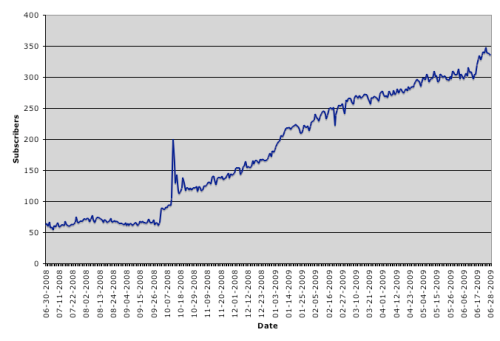
This chart shows how the site’s RSS subscriptions have grown since June 2008 (according to Feedburner.) These numbers should be taken with a grain of salt, but they do illustrate that I’ve had a very fortunate year! The big spike in October came from being linked by Kotaku and the front page of Digg in the space of a week (many thanks to Maggie Greene.)

This year I wrote 41 posts, overhauled my blog design twice, and made my first two non-trivial games: Inventory Tetris and Rockwell, Papyrus, Skia. There’s more to come! I’m currently hard at work on a substantially larger secret project in pygame, and experimenting with flixel when I have a moment to spare.

More significantly, this last year saw the game blogging community really begin to gel. The conversation that started in blogs and comments moved to Twitter and the #GBConfab IRC channel, then came full circle as cross-posts, podcasts and shared experiences. The game writing archive Critical Distance was born out of this spirit of collaboration, and will hopefully serve to further expand the conversation.

In fact, the game blogging community is already so large that I do not feel that I can adequately thank everyone individually. Therefore, I’d like to thank all of you for your support, your critical insight, and your humour. I look forward to many more trips around the sun writing and learning with you all.

To all my quieter readers: thanks for sticking around, and happy Canada day!

→ 4 CommentsTags:

Happy Single Earth Orbit!

Miscellaneous

I’ve done my best to resist celebrating arbitrary milestones in this blog. I silently hit my 100th post a while back, as well as various fractions of a year. However, you’ll have to excuse my pride now as The Quixotic Engineer is one year old today.

Feed Statistics

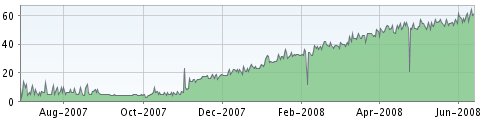
For the curious, here’s a chart of my RSS subscription growth over the last year. The first big peak was the day my Gmail spam post was linked by Lifehacker, and the count has been steadily growing ever since. The occasional sharp valleys are days when Google Reader didn’t publish a subscriber count.

Writing this blog has been rewarding in ways that I really did not expect. The most obvious benefit is that my writing ability has significantly improved through frequent practice. I’ve also had a chance to learn a great deal about web technologies, such as PHP, JavaScript, XHTML and feed syndication (RSS.) Furthermore, I’ve worked with some great open source applications, such as GIMP, Audacity, and WordPress.

More importantly, I’ve had a chance to get to know some really interesting people. Blogging is largely a social activity, and I think that getting to know fellow bloggers with similar interests is the best part. Many thanks to Michael, Nav, Leigh, Mitch, Dan, Ben, Corvus, Daniel, Dave and Tim for all the stimulating and thoughtful conversations and debates.

Thank you to all my other (quieter) readers as well. It’s very edifying when someone likes your writing enough to stick around. I’ll do my best to keep writing quality posts in the future. One year down, here’s to many many more!

→ 10 CommentsTags:

The Watermelon Analogy

Miscellaneous

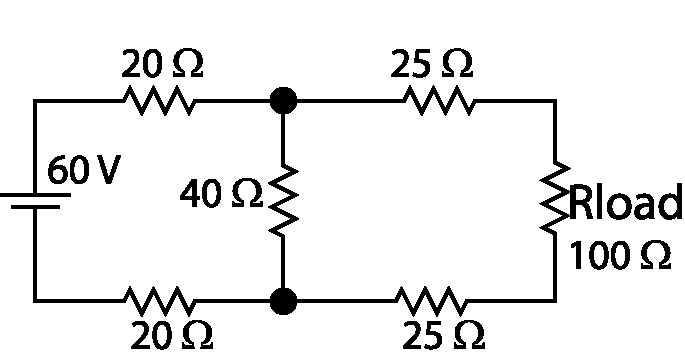
A simple circuit

As part of the Software Engineering curriculum, I was required to take “Principles of Electrical Engineering” this semester. This is a mandatory course for all engineers at Concordia, so the class was full of people working in a somewhat unfamiliar domain. It was a tough course, but fortunately I had a good background in electromagnetism from my pure & applied science Cégep degree (Cégep is pre-university in Quebec.)

One thing I noticed while taking the class was how most students simply reduced the circuit analysis to math and never bothered to properly grok how electrical systems actually work. I was definitely guilty of this as well; I have only a very abstract notion of what capacitors actually do but know enough to blindly calculate their impedance. Indeed, some of my classmates had only a vague notion of the physical difference between voltage and current.

I’ve had to explain the basics of electricity to others once or twice in my lifetime, and I’ve come up with a rather simple analogy to do so. As a disclaimer, I’ll repeat that I’m not an electrical engineer and have only a rudimentary knowledge of electrical systems. There are many good analogies to explain how electricity works, and I happen to like this one.

Watermelons!

Imagine the circuit as a system of roads, and on these roads are trucks delivering watermelons. Why watermelons you ask? Because they’re delicious, don’t ask silly questions. These trucks drive around the circuit, picking up watermelons (charges) at the farms (voltage/current sources) and dropping them off at the markets (resistors.) Therefore:

  • The trucks are the charge carriers, and number of trucks is analogous to the current (amperes.) In other words, a current of 10A in a systems can be viewed as having ten trucks driving around.
  • The voltage (volts) is comparable to the number of watermelons. Saying the potential difference across a resistor is 40V is analogous to saying 40 watermelons were dropped off at that market.
  • Resistance (ohms) is the number of watermelons per truck that need to be dropped off at the market. If a resistor has a value of 10 ohms, then each truck that passes it will drop off 10 watermelons.

Ohm's Law

How well does this analogy hold up? It properly illustrates Ohm’s law, the quintessential electrical formula. The law states that potential difference across a resistor (V) is equal to the current (I) times the resistance (R). In other words, the number of watermelons dropped off at a market is equal to the number of watermelons per truck times the number of trucks.

As with most analogies, this is a rather gross simplification. Amperage is not actually a measure of the number of charge carriers, but rather the number of charge carriers per second. In many ways electrical charge (Coulombs) is a better analogy for the number of trucks, and amperage for a more general “flow of traffic.” Furthermore, voltage is actually defined as the amount of energy in Joules (watermelons?) per charge carrier (truck.)

Despite its flaws, I feel that the watermelon truck analogy does a better job of defining charge carriers and potential than the popular water comparison. If you have an analogy that worked for you when learning about electricity, I’d love to hear about it in the comments.

→ 4 CommentsTags:  · 

We’re Live!

Miscellaneous

…but everything is still under construction. Bear with me!

UPDATE: The site is looking slightly less “default WordPress”, and I’ve imported all the pages from Blogger. I’ve redirected Feedburner over to the new site, here’s hoping everything goes smoothly.

UPDATE 2: I’ve done some more behind the scenes work, including redirecting all traffic from my Blogger site to here and fixing broken embedded objects. I’m still hoping to play around with the CSS, as well as change how my sidebar archive looks.

→ 5 CommentsTags:  · 

The Quixotic Engineer is Moving!

Miscellaneous

Blogger’s been good to me for the last 7 months, but I recently got it into my head that owning my own domain would be a good investment. Over the next few days/weeks, I’ll be moving this whole operation over to a WordPress blog at www.gangles.ca, Gangles being a handle I’ve used for years (and it seemed more memorable than quixotic-engineer.ca)

I used NetFirms as a domain registrar, hence the current splash page, but will be using A Small Orange as a host at Tim‘s recommendation. I’ll keep you guys updated here as the site progresses, here’s hoping it all goes smoothly.

I’m also looking for good WordPress plug-ins, so please drop me a comment with your suggestions.

Tags:  ·  · 

© 2007-2011 Matthew Gallant, hosted by A Small Orange, powered by Wordpress, theme based on Basic.