Last month, Tom Armitage wrote an excellent post about consensual play. The term denotes a subset of emergent gameplay1 which relies on both players agreeing to rules of conduct that are not enforced by the game itself.
Tom’s post was also my first exposure to Grifball, a sport-like player-created game mode in Halo 3. Robust mapmaking tools and heavy official support now make it a poor fit for the consensual model2, but Grifball remains interesting both as a case study for emergent gameplay and as a unique well-balanced game mode.
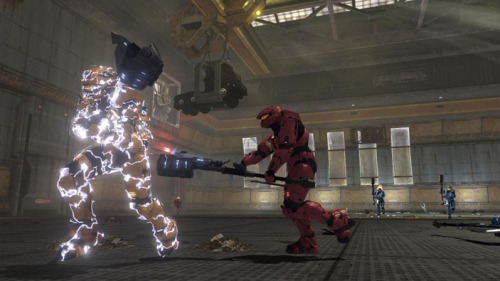
Grifball was invented by Rooster Teeth (a production team best known for their Halo machinima Red vs. Blue) and named after Grif (an orange Spartan character from the aforementioned series.) The game is a modified version of Halo‘s “Assault” mode, with the following custom rules:
- The map is set to a custom version of Foundry that has been edited into an empty square court with opposing goals.
- The players are all equipped with melee weapons (Gravity Hammer and Energy Sword) with infinite ammo. Grenades and equipment are disabled.
- Weapon damage is doubled and player health is set to 10%, so the Gravity Hammer’s concussive blast can sometimes kill in one hit.
- The player currently in possession of the bomb is granted 150% speed, overshield and bright orange armour.
- Players respawn at their goal after 3 seconds.
- The bomb timer is set to 1 second, so there is no chance to defuse it.
- Planting the bomb at the opposing team’s goal scores a point and ends the round. The team that’s ahead after five rounds wins the game.
It’s worth noting that none of these changes require external mods or hacking, but rather are easily accomplished using Halo 3‘s powerful map editing tool. If mapmaking isn’t your thing, you can grab the Rooster Teeth version off Bungie’s file sharing service or wait for the official playlist during double EXP weekends.

What’s fascinating about Grifball is how well it emulates a sport (or rather a sport game.) Like basketball or hockey, players must alternately think offensively and defensively as the bomb changes possession. Movement suddenly trumps aiming, as players must gauge distance for successful attacks and create openings to score. The best players are the ones who can move in tricky, unpredictable ways and psych out their opponents. In terms of skill and strategy, Grifball has much more in common with virtual rugby than it does a shooter.
Grifball is also surprisingly deep and well-balanced, especially for a game that was assembled on top of a rules calibrated for ranged fighting. For instance, the game’s three weapons create a rough circular hierarchy3 (shown in the diagram above.) Defensive players must therefore alternate between using the sword to chase down the bomb carrier and the hammer to take out their support. Experienced offensive players can also use the repulsion of the Gravity Hammer to propel a jumping bomb carrier over the heads of the defending players, a sort of “Hail Mary” play that can be very effective. There’s a deep rabbit hole of player vocabulary and strategy to explore, if you’re so inclined.
In his post, Tom Armitage proposed that consensual games like Grifball are so good because they have survived thousands of Xbox Live players playing and refining them. Grifball is now nearly two years old and is enjoyed by several divisions of competitive league play. If you’re one of the 8 million people who owns Halo 3, I strongly suggest giving this unique player-created game mode a shot.

1 “The creative use of a video game in ways unexpected by the game designer’s original intent.”
2 The rules are entirely enforced by the game, therefore there is no need for mutual consent.
3 Experienced players would probably argue that it’s a bit more complex than that (see this chart).




May 14th, 2009 at 11:39 pm
Good introduction to the game, and good linking! I didn’t even know there were leagues that did this and people who did video with commentary! I could kinda see it getting boring after awhile though, since the nuances are deep but kinda codified. I think it could stand to have a few different positions instead of having everyone equal.
The only thing that really annoys me about Grifball is that they put it in regular playlists sometimes (not just the XP weekends), and when it comes up everybody goes “Oh come on, not Grifball!” It’s a really acquired taste, and it doesn’t make sense to force players who are interested in playing Halo 3 to suddenly switch into Grifball mode on the fly and have a good time with it.
May 15th, 2009 at 2:04 am
I loved the idea of Griffball from the first time I heard it. As you say, this kind of emergent potential is a great thing in games and I only want to see more of it happening. =D
May 15th, 2009 at 9:20 am
Wow, I’ve never heard of this before (probably because the idea of taking Halo online scares me). The notion of continuous refinement is very interesting… people with little or no professional design experience trying to figure out what rules can make for a fun time, all the while confined by *another* set of rules (Halo itself).
I wonder if this happens in other games? Like with GTA IV’s free mode, or Burnout Paradise. I remember spending many hours doing “sheep bowling” with my friends in Worms as a teenager…
May 15th, 2009 at 11:05 pm
@Simon: Which regular playlists does it show up in? Ones that already feature special modes?
@Ben: You should give it a shot this weekend!
@thesimplicity: Check out Tom’s post for more examples, the PGR Cat & Mouse is awesome.
May 16th, 2009 at 7:20 am
It showed up in the Mythic Map Pack playlist for the first two months or so it was out after the Halo Wars preview map pack download thing. I guess since they wanted to show off the fact that they’d made a map for it in Sandbox. Haven’t played it in a few months though, so perhaps they axed it from the playlist when the map pack went up for open sale on XBL.
Before that, yes, I think it was during times when they were experimenting or changing things up by incorporating special modes into regular DLC lists. I guess I don’t consider a DLC list a “crazy anything goes” list, since you have to play them to get the maps you might want.
The biggest problem with making it non-voluntary is that the note you have about the game enforcing the rules is completely off if you get one guy out of eight who doesn’t want to bite the bullet and play the game. One crazy suicide hammer guy on your team and you’ve wasted 15 minutes of your life.
March 1st, 2010 at 11:04 am
I’ve been playing Grifball ever sense its creation two years ago. I haven’t been able to play on an official team or in Rooster Teeth’s official tournaments yet, but this past weekend (Double Exp Weekend – Grifball) I was able to get a few try out videos out to some team managers, so hopefully I’ll have a place in.
However, if you thought that Grifball was boring, then you weren’t playing with the people who are actually PART of the tournaments.
It was announced that with the release of Halo: Reach, will come with a new game type. There is speculations that this new game type is Grifball, and there is further support of that theory with the audio clip Burnie Burns posted on the Rooster Teeth’s home page.
I can’t wait to see where the game goes, and how it evolves with the next two or three years to come.