Bloom is a shader effect used to simulate the real appearance of very bright light. While it was once considered too hardware intensive for real-time gaming, modern systems with HDR rendering make frequent use of it. So frequent, in fact, that the effect has become synonymous with “next-gen” graphics. Today I’d like to take a closer look at bloom, and address what I feel is an unfortunate trend in its use.
Bloom aims to recreate the optical effect known as the Airy disc. In the real world, when light passes through a circular aperture such as your eye it diffracts, causing flaws that limit the maximum resolution of even a perfect lens. These defects are negligible for normal incoming light, but very bright sources can appear to bleed into surrounding darker objects.
In graphics processing, this effect is simulated by blurring the bright parts of the frame buffer image in post-processing. In simpler terms, the bloom effect is only applied once the objects (3D vectors) have been converted into an image (pixels), a process known as rasterisation. A mathematical function (usually Gaussian blur) is then applied to the bright parts of the image, which blends the brightness into the surrounding pixels. Not only does this simulate the Airy disc, but it often has the added benefit of smoothing out aliasing artifacts (“jaggies”) and particle effects.
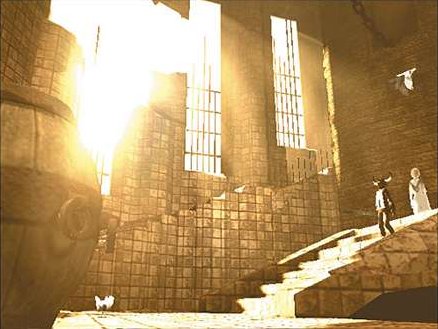
While it was a staple of late ninteties tech demos, Ico, released for the Playstation 2 in 2001, was one of the first video games to use a bloom filter in real time. The effect helped give the game’s ruined castle a distinct sun-washed look, an aesthetic that was repeated in its prequel Shadow of the Colossus four years later.
Ico was ahead of its time in many ways, and bloom did not see common use on consoles until the seventh generation began in 2005. The Xbox 360 and Playstation 3 could render graphics with high dynamic range, meaning a larger contrast between very bright and very dark objects (high-end PCs had this capability several years ealier.) Under standard lighting white was the brightest possible frame buffer value, but with HDRR the graphics processor could distinguish between a white t-shirt and the white of the sun. Combined with the massive increase in hardware capability, it suddenly became trivial to add a bloom filter to games and, unfortunately, that’s exactly what happened.
To properly illustrate my concern about the proliferation of bloom, I’d like to show you some examples of bloom gone wrong:
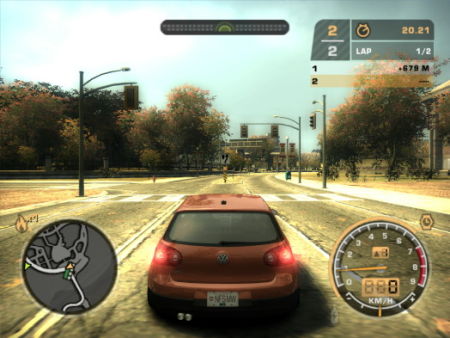
Need For Speed: Most Wanted: This must be America, because the streets are paved with gold!
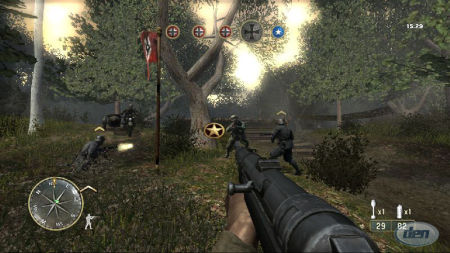
Call of Duty 3: A relatively benign example. Everything looks fine beneath the horizon, but oh my the sky is on fire!
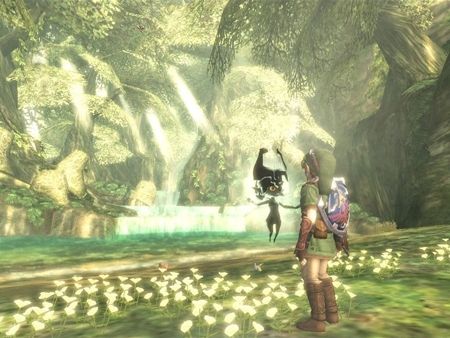
The Legend of Zelda: Twilight Princess: The reflecting waterfall might be forgivable, but the flowers?

The Elder Scrolls IV: Oblivion: The ruins in the background are an indistinct white mess. [full size]

Halo 3: The weapon and explosion effects in Halo 3 use a whole lot of bloom.
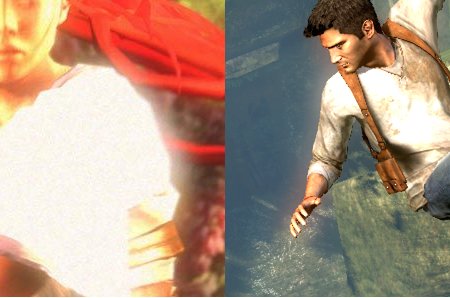
Heavenly Sword and Uncharted: Drake’s Fortune: Notice how the white shirts bleed into the environment around them.

Two Worlds: The nefarious duo snow and lightning have turned everyone and everything white. [full size]

The Legend of Spyro: Dawn of the Dragon: Would you believe that this screenshot inspired this entire post? What a disaster.
I’m not trying to suggest that modern graphics are insufficiently photorealistic. Quite the opposite in fact; it’s the drive for realism that’s pushing developers to add bloom to as many games as they possibly can. However, as the screenshots above demonstrate, too much bloom is as detrimental to realism as none at all. What’s worse is that the fine detail that high resolution gaming can provide is being lost in a sea of brightness. Like in Ico, using highly noticeable amounts of bloom should be an aesthetic choice, and not broadly applied to all games.
Notes:
- Many thanks to Renaud for helping me with the technical aspects of this post.
- I’d also like to thank the many people who suggested games with too much bloom to check out.
- For additional reading on bloom, check out The Instruction Limit, Gamasutra, and the XNA Creators Club.









July 18th, 2008 at 5:14 am
Ha! Great to see what the Twitter “call for bloom” turned up! Love the post, but I don’t think I’m as ‘bloomed out’ as you are, at least not yet.
I’m really enjoying the difference that bloom and HDR Lighting adds to Oblivion, as it gives the impression that I’ve just walked outside into the sunlight from a darkened room and that my eyes still need to adjust. Mmm, lovely. I totally see your point with Spyro though… I mean… damn.
July 20th, 2008 at 7:12 pm
The trouble I see is that EVERY modern game is going for this “just walked outside” look, and the effect persists even if you stay out for a length of time. I can see how the effect is useful and can add punch to the visuals, but I wish developers were a little more selective about using it.
July 25th, 2008 at 9:21 am
Of course, several of those games look great in motion, aided by the same bloom effects. Screenshots lie.
July 25th, 2008 at 10:02 am
@DJH:
While I agree that the bloom effect is exaggerated in still shots, I’m not using screencaps as my only basis for my assertion. I’ve actually played the majority of these titles, and even in motion the over-use of bloom both detracts from the realism and covers large portions of the screen in unpleasant glare.
May 12th, 2009 at 1:00 am
[…] problema llega cuando se abusa del Bloom Effect. En la utilización de filtros, técnicas y demás posibilidades gráficas al […]
November 19th, 2009 at 8:08 pm
You forgot Roller Coaster Tycoon 3, which wants the player to feel the warmth of the air by blowing the sun out excessively. Google images found me this.
It got to the point of ridiculousness when my entire screen was so bright with washed out yellow that I could hardly see my park, nonetheless make changes to it and, you know, play the game.
December 15th, 2009 at 9:12 am
Excellent post! Very entertaining.
January 21st, 2010 at 2:02 am
I think you’re wrong with Heavenly Sword, if you played it, Nariko’s body and armor glow before she dies when she becomes a goddess, I do think you have a point, but part of what makes games so awesome is seeing things not seen in reality, bloom effect enhances the image, I do accept Spyro’s screnshot is just absurd :P
February 13th, 2010 at 9:47 pm
VG Cats knows what you mean.
http://www.vgcats.com/comics/?strip_id=224
Now if you’ll excuse me, I have a killer headache at the moment.