Firstly, to clarify, this is not a post about the early-Genesis tribute band The Musical Box, although I hear that they’re great. Instead, I thought I’d combine some of my recent musical discoveries in a (potentially) monthly post. I’ll be embedding videos of the artists I mention only until I can find an audio alternative, since the lifespan of Youtube videos is often measured in weeks due to copyright policing.
I’ve dabbled in folk music, mostly enjoying the very famous artists from the 60’s and 70’s (Leonard Cohen, James Taylor, Gordon Lightfoot, etc.) After speaking with my friend Malini, who brought up artists such as Tori Amos and Ani DiFranco, I noticed that my preference for folk artists was majorly skewed towards male singers. That trend has begun to change recently after another friend introduced me to indie folk singer-songwriter Feist. Since her single “1 2 3 4” has been getting noticeable radio airplay after that new iPod commercial, I thought I’d talk about the slightly less well known Regina Spektor instead.

I first saw her perform on Conan O’Brien a few months ago, but only recently have I had a chance to enjoy her “Soviet Kitsch” and “Begin to Hope” albums. They’re both musically, lyrically and thematically brilliant. Her voice has an unconventional quality that I can’t quite pinpoint, which is emphasized of course by her frequent use of irregular vocal techniques. Perhaps being raised behind the Iron Curtain gives her a unique view on things, since her lyrics are whimsical and often silly, yet feel soulful and beautiful all the same. Wikipedia tells me that this is a characteristic of the “anti-folk” scene, but I’m not a big fan of fussily pigeonholing everyone into a restrictive musical genre.

If you’ve played through the excellent game Portal, which I wrote a little on last week, then no doubt one of your favorite moments was the song at the end entitled “Still Alive”. This song was written by folk rock singer-songwriter Jonathan Coulton, a man who has made great strides for both internet published musicians and the Creative Commons license. Being a programmer, I was first exposed to Coulton’s music about a year and a half ago via his geeky hit “Code Monkey“. His quirky and nerdy lyrics reminded me a little of the first few Barenaked Ladies albums, so I was immediately a big fan.
While Coulton does publish under Creative Commons and encourages people to spread his music around, keep in mind that he does make a living off his internet music. As such, I urge you to check out his MP3 store where you can listen to all of his songs and download them for the standard $1 each (no DRM either, eat your heart out major labels). My personal recommendations include the aforementioned “Code Monkey”, “The Future Soon”, “Ikea”, “Re: Your Brains” and his folk cover of “Baby Got Back”.
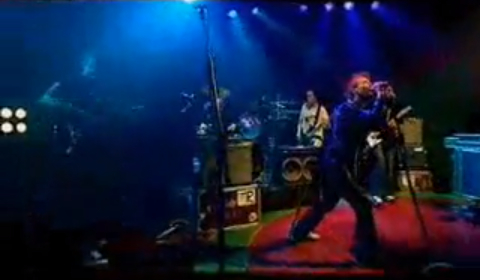
Lastly, along with just about everyone else on the internet, I’ve been checking out Radiohead’s latest album, “In Rainbows”. While their choice of digital distribution isn’t exactly going to send the record executives packing just yet, I believe that this is most definitely a step in the right direction for the music industry.
As someone who really only got into Radiohead less than a year ago, I feel ill equipped to judge “In Rainbows”. I do believe I’ll just default to agreeing with Chris Dahlen, who wrote a sensible piece on the subject. It is in that spirit that I embedded Radiohead’s excellent cover of “Nobody Does It Better” in lieu of one of their new songs.
That concludes volume 1 of my Musical Box experiment, here’s hoping that I have the discipline to pick it up again next month!




October 25th, 2007 at 3:21 pm
I agree that Radiohead’s ditching the labels isn’t going to change the world overnight, but whoa… I’m actually gonna release my new CD on iTunes. Cause if you think about it, it costs an indie artist over $1K to print up CDs when if they just set up a site with all the lyrics and artwork (can pretty much be done for free on wordpress or blogger), there’s a better chance of recouping the recording costs earlier on.. then opening the door to actually being able to afford to print up the CDs.. instead of just doing it because it’s what you’re supposed to do to “make it”. Hopefully this frees up more and more artists to do what they do best; write and perform great music :)
October 25th, 2007 at 5:19 pm
I’m generally in agreement with you. The link I posted to Scrawled in Wax has some interesting counter-points:
“1) In Rainbows is still being released as a CD through the majors; 2) this would all be a bit irrelevant for any band that wasn’t already huge.”
“Even though I believe Radiohead has their heart in the right place, that they can release an album with a next-to-nothing price tag is a function of their pre-existing fame and wealth, not simply their ideals.”
It’s also easy to forget that the average American consumer is a relative luddite (~45% of Americans use e-mail says Google) and probably still wants the tangibleness of a CD. This will, of course, change more and more in the coming years.
Indie bands, however, do have the advantage of marketing mostly to the kind of audience that is likely young and net-savvy enough to prefer MP3s. That’s why I’d love to see more bands become successful using the “Jonathan Coulton model”, it works very well for addressing that specific audience.
Thanks for your comment!
October 28th, 2007 at 5:00 pm
In spite of the number of Americans lacking the knowledge or wherewithal to access music on the net, you also have to remember that Radiohead fans are probably more connected and in the know than your average citizen. Ergo, it stands to reasons that a CD release of In Rainbows will not have that much of an impact financially. Mainstream media has already covered the digital release enough that even casual Radiohead fans know where to get it.
All things considered, I really don’t get the cheerleading being done by people who don’t work for the RIAA. How does it benefit any of you if labels maintain their lecherous grip and litigious attitude over the recording industry? Answer: it doesn’t. It only benefits greedy corporations who will do anything to maintain the status quo. You can replace “recording industry” with just about any other and make the same statement.
As far as it being irrelevant for any other band that wasn’t already huge. . .well, I think that’s missing the point. Change won’t happen overnight, but it has started and will gain momentum. Eventually the average American luddite will be a dying breed, and the non-tech savvy consumer will be the oddity. Radio is still currently the biggest channel for delivering new music, but even that method is danger of dying (thank you, Clear Channel homogeny). Sooner or later new music will be discovered through more independent and hi-tech means, and then the new business model will replace the current one.
For now the recording industry can spin its wheels all it wants. It’s on the way out, and no amount of punditry will stop it.
October 28th, 2007 at 7:20 pm
You sound as if you’re disagreement with me, but I think we’re essentially saying the same thing. We’re both saying that the major labels are in for hard times ahead, and that a fundamental shift in the way that music is consumed is approaching.
You say that “eventually the average American luddite will be a dying breed”, but the reality is that it will likely be a few decades before techies are the profitable majority. While you’re correct in saying that most Radiohead fans are tuned in enough to pick up the digital copy, other platinum selling artists (think Michael Bublé, Keith Urban) would absolutely sink trying to distribute this way. Generally, these kind of vanilla artists (sorry Bublé fans, Bobby Darin did it better 50 years ago) are the ones the “luddite majority” enjoys. It’s this audience that might very well take decades before they become accustomed to buying ethereal ones and zeroes through the series of tubes.
I applaud Radiohead’s endeavor, I really do. We need big name artists to do things like this in order for digital distribution to pick up momentum. However, I personally believe that the real innovation in distribution lies with self published artists like Jonathan Coulton who have become successful with zero help from any record label.