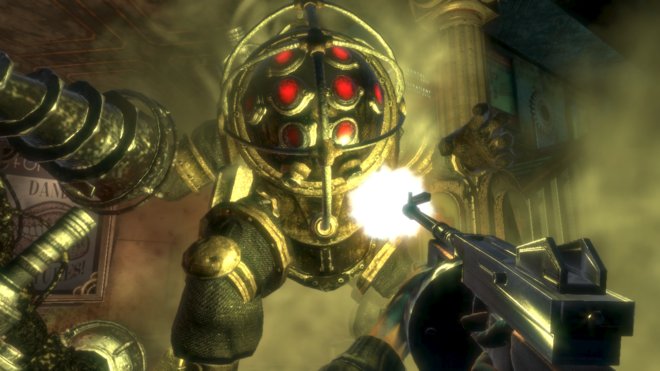
Last Friday it was announced that a Bioshock feature film was in the works, to be helmed by Gore Verbinski of “Pirates of the Caribbean” fame. In theory this is terrific news, Bioshock was one of my favourite games of last year. Its objectivist theme and unique setting made it rich for analysis, and it spawned several terrific essays from some of my favourite games writers.
However, I can’t help but feel ambivalent about this movie deal. Despite the fact that video games and blockbuster films have a bad history with each other, it seems that Hollywood is still chomping at the bit to churn out more. More importantly, there are several outstanding qualities of Bioshock that I believe cannot be faithfully reproduced in a non-interactive medium.
After thinking long and hard about whether a Bioshock film would “work”, I believe I’ve come up with some decent arguments for both sides. I’ll begin with the case against.
Perspective
Video games have an almost exclusive license on the first person perspective in visual media. In recent years, there have been several games that have made use of this perspective in particularly interesting and effective ways. For instance, the execution scene in Call of Duty 4 was extremely jarring because it was shown from the perspective of the condemned man. The apartment raid at the beginning of Half Life 2 was also greatly enhanced by the first person view.
The use of the FPP was used to great cinematic effect in Bioshock. For instance, I would rank the bathysphere descent into Rapture as one of the most unforgettable moments in gaming. This is also true of the now infamous scene with Andrew Ryan towards the end of the game. The decision to harvest the Little Sisters was so gut-wrenchingly difficult because the little monster was squirming in your digital hands. Throughout the game, control of the camera was only rarely taken away from the player, and only at certain significant points. This helped to reinforce the themes of control and choice.
I’m highly sceptical that these experiences can be faithfully reproduced in traditional third person film style. There is a staggering difference between watching a digital representation of one’s self compromise their humanity in order to survive in the underwater dystopia and watching (oh let’s say) Nathan Fillion do it. Furthermore, moving into the third person means that suddenly this character must have an appearance, dialogue, and personality. This segues into the problem of…
Choice
Bioshock’s main character, Jack, has very little discernible appearance or personality (minus one out-of-place piece of dialogue in the opening scene.) He is an empty vessel, which the player fills with their own character, desires and personal narrative. He is essentially “you”, a digital extension of the self. I would argue that this small detail is critical to making the game’s overall theme of “choice” work. It’s not Jack choosing whether or not to sell his soul to survive in Rapture, it’s you.
To make matters worse, in film the choice between right and wrong disappears entirely. Jack is bound to confront a Little Sister at some point in the film, and he’ll either harvest her or he won’t (I’m betting the latter, Hollywood isn’t very comfortable with morally ambiguous heroes.) Whichever outcome ends up in the final script will be the choice Jack makes every single time you watch it.
Will this make a difference in the film? It’s hard to say. There was a lot of pre-release hype coming from Irrational Games about “choice” in Bioshock, but in reality very little of it was built into the narrative. You either harvested the Little Sisters or you didn’t, resulting in one of two black & white endings.
Furthermore, it is entirely possible that Verbinski’s team may choose to focus the narrative of the film on Bioshock’s other outstanding themes, such as objectivism. However, from my perspective, the idea of choice is so deeply tied into every aspect of the game that concentrating on anything else would be a completely different story. I suppose this isn’t necessarily a bad thing.
Ecosystem
To me, one of the most fascinating aspects of Bioshock was how Rapture worked as a living (dying?) city. The enemy A.I.s often interacted together in strange and unpredictable ways. For instance, sometimes an enemy splicer would decide to pick a fight with a Big Daddy, resulting in a heated battle that did not involve you at all. Staying alive in the game depended greatly on one’s ability to figure out how the various elements of Rapture’s ecosystem (security cameras, splicers, Big Daddies, turrets, exploding barrels) were going to interact.
The stroke of genius in this equation was making the Big Daddy and Little Sister team a sort of neutral entity in the world. Having a wandering boss which the player could chose to engage at their convenience really tied the entire ecosystem idea together. In fact, it was the Hunting the Big Daddy video that initially convinced me that Bioshock was going to be new and different.
I concede that the Big Daddy and Little Sister characters are iconic enough to remain scary and interesting even in a non-interactive medium. However, take away the idea of “ecosystem” and the lumbering Big Daddy is really no different than any other movie bad guy. Sure they might include a token scene with a Little Sister crying for “Mr. Bubbles”, but it won’t have the same weight without the associated guilt of knowing that you provoked and killed a neutral creature (bringing us back to the idea of choice.)
Coming this weekend: arguments in favour of the Bioshock film.


May 16th, 2008 at 10:06 am
Got linked here from twitter by BrainyGamer and I’m glad I clicked through! Thank you for illuminating precisely the problems with a BioShock movie. The game is so dependent and such a critique of circumstances that are entirely unique to gaming that I cannot fathom how this will translate well to the cinema. Yes, a movie could present the world and flesh it out and look visually fantastic, but the core essence of what makes the game so outstanding will not translate. I truly hope style doesn’t win out completely over substance in this case.
May 16th, 2008 at 10:52 am
Good post Matthew. I agree with your ‘against’ points and am interested to see what you’ll have in the ‘for’ column.
I’ve only played the demo of Bioshock, but was really impressed by the overall tone of the game. One really interesting point about was raised by Chris Sullentrope on Slate. There, he suggested that if Bioshock is a critique of the libertarian idea that ‘you are free to determine your own destiny’, then the denial of choice for one’s ‘digital self’ becomes significant in terms of the narrative and themes etc. I guess you can still make similar points in film, but I think you’re right when you say that it won’t have the same personal impact.
May 16th, 2008 at 5:57 pm
@Robert Thank you! I enjoyed what you wrote about GTAIV and TWEWY as well.
@Nav I’ll have to look up that article, it sounds really interesting.
May 16th, 2008 at 9:33 pm
[…] My pal Matthew outlines why a Bioshock movie is a probably a bad idea. […]
May 16th, 2008 at 9:45 pm
There’s another reason that BioShock was such a wonderful game; It made fun of gamers and pointed out a number of key elements that gamers understand – achieving forced objectives before moving on. Given, this only really comes into play later in the game, it had a huge affect on the long time gamers who’d be effectively spat in the face.
Many of the elements you’ve focussed on above also make the assumption we’re going to be receiving a film centred around a nameless protagonist character such as Jack. However, there’s always room for the film to begin on New Years Eve when the splicers attack, or documenting the rise and fall of Andrew Ryan or the aftermath of Jack’s actions.
I’m just brainstorming here and I’m interested to see what happens in the film, and you’ve raised some excellent points, but I wouldn’t be pessimistic just yet :)
May 17th, 2008 at 8:11 pm
@Daniel: I agree, I think a movie with a completely different focus / plot / narrative but set in Rapture would be terrific. That’s actually one of the “case for” points I’ll be writing up shortly!
May 19th, 2008 at 10:16 pm
Ahh, I see. Well, I look forward to reading them! Haha.
May 20th, 2008 at 3:41 am
Hey, I really liked this post: much more thought-out than the usual “so there’s going to be a Bioshock movie! Hmm!”
Playing Bioshock I always wanted to experience that setting in a deeper sense than was possible with a typically frenetic action game. Audio diaries were okay but of course that’s not going to play on film. That’s my highest hope for the Bioshock movie: that they realise that setting, that concept and Ryan’s ridiculous ambition in a way that a game that was about shooting and not talking couldn’t.
May 21st, 2008 at 11:45 am
@Duncan Thank you!
If the film turns out to be anything like what you just described, I think it’ll be fantastic.