Last week my arguments against the Bioshock movie revolved largely around the fact that I do not believe that the game’s experience can be faithfully reproduced in a non-interactive medium. My two arguments in favour of the film aren’t so much counter-arguments to my last observations as they are sort of lateral benefits.
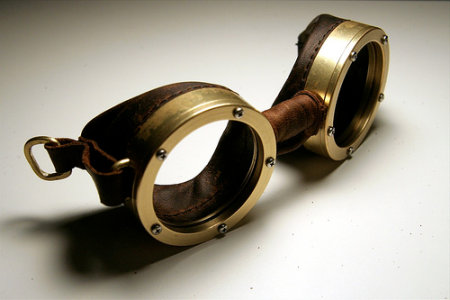
Steampunk
The niche subculture of steampunk has been getting a lot of Internet attention lately, which translates into roughly one or two casual mentions in paper publications (check out the New York Times article or the even better one they didn’t publish.) The whimsical charms of the genre have been well explored by books (The Difference Engine), comics (The League of Extraordinary Gentlemen), video games (Final Fantasy VI), anime (Fullmetal Alchemist) and Japanese cinema (Howl’s Moving Castle.) However, the genre has been woefully underexplored in Hollywood.
I’m no film buff, but even I can rattle off a few steampunk films made in recent years (Wild Wild West, The League of Extraordinary Gentlemen, The Golden Compass.) They all have two things in common: the fact that they were adaptations from other media and the fact that they were ultimately forgettable (which is the polite way of saying they sucked.) Indeed, these films almost make me wish that Hollywood would go back to ignoring steampunk.
The truth is that I would be very pleased if the Bioshock adaptation were to be the exception to the rule and finally turn it around for Western steampunk cinema. The genre’s impossible machines and incredible scale make it uniquely suited for the sort of “Hollywood magic” that is usually wasted on brainless action films nowadays. Furthermore, Bioshock proved that combining steampunk visuals with steampunk audio was a recipe for success. Watching someone being stalked by insane splicers while a broken phonograph in the corner wails “How Much Is That Doggy in the Window?” would alone be worth the price of admission.
A Story Worth Telling
As Daniel and Duncan commented on my last post, there is in fact a story within Bioshock that may be a better fit for film; a story told only through audio diaries, posters and dialog and ultimately filled in by the player’s imagination. I’m speaking of course of the rise and fall of Rapture, and the conflict between Andrew Ryan and Frank Fontaine. Using the film to fill out the city’s backstory would be an interesting idea, and would definitely mitigate some of the criticisms from my last post.
However, I have somewhat mixed feelings about this idea. In the video game, the story of Rapture is essentially told backwards. For instance, we see a Little Sister long before we discover what she is. We enter the abandoned buildings and see the party remains without knowing what caused the people to flee. Excising the mystery by doing things the other way around would definitely make the characters and setting much less compelling.
Alternately, I would propose that the best thing the Bioshock movie could do would be to rework the video game’s weak denouement. Anyone who has played the game knows that the story takes a sharp downturn after the events at Hephaestus. While the scenery remains interesting (especially the “school” for Little Sisters), the game’s last third introduces plotholes, a completely unnecessary last boss fight and two ultimately unsatisfying endings. From interviews with Ken Levine, my general impression is that this sloppiness was due to time constraints and upper management pressure. The film could be Irrational’s chance to correct these errors and finally give Bioshock the coherent ending it deserved.
For more Bioshock goodness, be sure to check out Michael Abbott’s podcast interview with Steve Gaynor of 2K Marin over at The Brainy Gamer.


May 23rd, 2008 at 7:15 am
I’ve yet to play Bioshock (or even obtain a system which can). I just wanted to point out that while The Difference Engine is often touted as an example of Steampunk, I thought it was extremely boring. I couldn’t even get past 200 pages. It seemed to me like the authors (William Gibson & Bruce Sterline) were more concerned with steampunkiness than with actually telling a story …
If you want some good steampunk, I’d recommend China Mièville’s Perdido Street Station. It actually describes a world that I think would translate exceptionally well to video games and film.
May 24th, 2008 at 10:05 am
There are a couple of things you have to factor into a current discussion about this project: the director (which you’ve already mentioned) and the screenwriter. Gore Verbinski took a 2 and half minute boat ride at Disney and turned it into one of the biggest money makers the studio had seen in a long time. Regardless of what you think of the last two films (and I think the studio had more to do with those troubles than Verbinski), on the first one he took a risk and stood by his choices. Also, in my opinion, he demonstrated with The Ring that he at least has the basic eye for proper tone in a horror film.
Now, as far as the screenwriter goes, John Logan is currently contracted to write the script based on Ken Levine’s story. On the one, Logan is responsible for the script to last years excellent Sweeney Todd. On the other, he also wrote Star Trek: Nemesis so your mileage may vary depending on what genre you’re traveling.
The key thing to remember, and this is what trips *many* a game based movie, is adaptation does not mean a literal interpretation of what’s in the game. Certainly there are interesting themes left to explore in the Bioshock universe and some of them can only be told through a medium such as film. But you have to realize that movie watching is far more passive than game playing, yet a good filmmaker knows how to immerse his audience as deep as the good game designer does. This is why I have faith in this project. If you’re expecting a dissertation on Marxism and Orwellian power corruption, you’re likely to be in for a major disappointment. First and foremost, the movie (like the game) has to be entertaining. You sucker them in with the flash, then you sneak in the substantive messages.
Believe it or not, I’ve got slightly higher expectations for Prince of Persia, largely due to (gulp) Jerry Bruckheimer’s involvement. Yes, I imagine he was part of the cause of Pirates becoming such a bloated mess at the end, but he knows how to put on a big show, no denying that. I’m not saying the film will end up being any good, but it sure as shit won’t be In The Name of the King.
May 25th, 2008 at 7:41 pm
@Skrud: I haven’t actually read “The Difference Engine”, but I had heard good things. I’ll be sure to check out “Perdido Street Station”, the little bits I picked up from Google sounded really interesting.
@Dave: You’re much more of a film buff than me, but I definitely agree that 2K games has lined up good people behind the film. I don’t expect the film to touch on political issues any more than the game did (that is to say lightly, for the most part.) If they can capture the excitement and wonder of Rapture I’ll be more than pleased.
I became extremely pessimistic about the Prince of Persia film when I heard that they cast Jake Gyllenhaal as the prince. It’s prince of PERSIA for crying out loud. The new cell-shaded game, however, looks very promising.
July 22nd, 2008 at 10:18 am
Apologies for the slight bit of thread necromancy, I’m link hopping.
If you’ve not seen it, check out the City of Lost Children for what I see as aesthetically one of the best examples of steampunk in cinema. Somewhat bizzare but with a few stand out performances.
I think you’re right. The relative lack of first person narrative places the player in the position of the protagonist in Bioshock and it’d not translate well in to the third person.
July 22nd, 2008 at 8:48 pm
Thanks David, I’m enjoying your observations in the Vintage Game Club. City of Lost Children is on my to-watch list, I’ve heard great things.